What Is the Difference Between Gin and Vodka? A Distiller's Honest Explanation
They start as the same thing. What happens next is what makes them completely different spirits.
This is one of the most searched questions in the spirits world, and most of the answers online overcomplicate it. The difference between gin and vodka is actually straightforward once you understand the basics, but there are a few nuances that even regular drinkers get wrong. As a distillery that produces both, we are in a good position to explain it properly.
The One Sentence Answer
Vodka is a neutral spirit designed to be as clean and flavourless as possible. Gin is a neutral spirit that has been flavoured with botanicals, the most important of which must be juniper. That is it. Everything else is detail.
The Longer Answer
Both gin and vodka start life as essentially the same thing: a base spirit distilled from fermented grain, potato, grape, or another starch or sugar source. This base spirit is distilled to a high proof to remove as much flavour and character as possible, producing a clean, neutral alcohol.
With vodka, the job is more or less done at this point. The goal is purity. A good vodka should be smooth, clean, and as close to flavourless as the distiller can achieve. Some vodkas are filtered through charcoal, silver, or other materials to remove any remaining impurities. The skill in making vodka is in the subtraction, taking things away until what remains is as pure and smooth as possible.
With gin, the base spirit is a starting point rather than a finished product. The distiller takes that same neutral spirit and introduces botanicals, the herbs, spices, fruits, roots, and flowers that give gin its flavour. Juniper must be the dominant botanical (this is a legal requirement in the EU and UK), but beyond that, the distiller can use whatever they choose. This is why the gin category is so diverse. Two gins can taste completely different from each other because their botanical recipes are entirely different.
How Botanicals Get Into Gin
There are two main methods. Steeping involves soaking the botanicals directly in the base spirit before redistilling the mixture. This produces a bold, robust flavour. Vapour infusion involves placing the botanicals in a basket above the spirit so that the rising vapour passes through them during distillation, picking up their flavours in a lighter, more delicate way.
At Wicstun Distillery, the Aromatic Yorkshire Dry Gin is made using a combination of both techniques, with heavier botanicals like coriander seed steeped and more delicate ones vapour-infused. You can read more about the full process on the gin making process page.
What About Flavoured Vodka?
This is where things get confusing. If gin is basically vodka with botanicals added, what is a flavoured vodka? Is a lemon vodka just a lemon gin without juniper?
Technically, yes. The production process is similar. The difference is that gin must contain juniper as its predominant flavour to legally be called gin. A flavoured vodka has no such requirement. You can flavour vodka with anything you like and it remains vodka as long as the base spirit meets the legal definition.
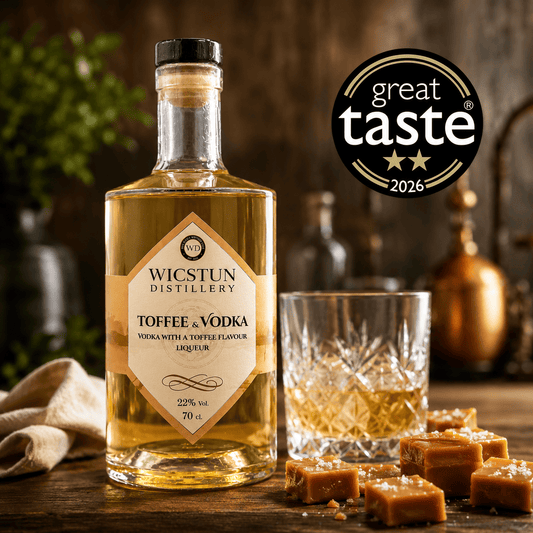
Wicstun's toffee vodka with salted caramel is a good example. It starts with a clean base spirit and is infused with real salted caramel to create a rich, indulgent flavoured vodka. If juniper were added as the lead flavour instead, it would be a gin. The base process is the same. The botanical choice is what determines the category.
Which One Should You Drink?
This depends entirely on what you enjoy and what you are using it for.
Choose vodka if you want a clean, neutral base for cocktails where the mixer or other ingredients are the star. A vodka martini, a Moscow mule, a Bloody Mary, or a vodka tonic all rely on the vodka being smooth and unobtrusive. Flavoured vodkas like the toffee vodka work well in drinks where you want a specific flavour without the herbal complexity of gin, like a toffee espresso martini.
Choose gin if you want the spirit itself to contribute flavour. A gin and tonic is a dialogue between the botanicals in the gin and the quinine in the tonic. A Negroni relies on the gin's herbal character to balance the bitterness of Campari and the sweetness of vermouth. Gin is the choice when you want the spirit to be an active participant in the drink rather than a silent carrier.
Choose both if you are building a home bar. Having a quality gin and a quality vodka covers almost every cocktail situation you are likely to encounter. From the Wicstun range, the aromatic dry gin and the toffee vodka together give you a versatile pair that handles everything from a classic G&T to an espresso martini.
Common Myths
Vodka has no flavour. Not quite true. A truly flavourless vodka is the goal, but in practice, the base ingredient and the distillation process do impart subtle differences. A potato vodka will have a slightly different mouthfeel from a grain vodka. Premium vodkas are smoother than cheap ones. The differences are subtle compared to gin, but they exist.
Gin is just flavoured vodka. This is technically accurate but misses the point. Saying gin is flavoured vodka is like saying bread is flavoured flour. The transformation is what matters, and the skill involved in balancing botanicals to create a cohesive, complex spirit is a craft in its own right.
Vodka is for people who do not like the taste of alcohol. This is unfair to vodka. Good vodka has a smoothness and a clean finish that is genuinely pleasant. It is not about avoiding flavour. It is about appreciating purity. There is a reason vodka remains the best-selling spirit category globally.
Gin gives you worse hangovers. No. The severity of a hangover is determined by how much you drink, how hydrated you are, and the congener content of the spirit (darker spirits generally have more congeners). Clear spirits like gin and vodka both have low congener levels. If you are getting a worse hangover from gin than vodka, you are probably just drinking more of it because it tastes better.
Try Both
The best way to understand the difference is to taste them side by side. Pour a measure of plain vodka and a measure of gin, both neat, at room temperature. Nose them. Taste them. The vodka should be clean and neutral. The gin should be aromatic and complex. Same starting point, completely different destination.
If you want to try both from a single Yorkshire distillery, Wicstun Distillery produces an award-worthy gin range and a growing vodka collection, all handcrafted in Market Weighton, East Yorkshire. The full range is available online with free delivery on orders over £50, and distillery tours include tastings of everything they produce, from the aromatic dry gin through to the dark rum and the toffee vodka.
Every product is vegan-friendly, made without artificial flavourings, and produced in genuinely small batches by a team that cares about what goes into the bottle.