Table of Contents
- What Makes Gin Distillation Artisanal?
- Botanical Maceration Techniques: How Flavour Gets In
- One-Shot Distillation vs Concentrate: Two Routes to the Bottle
- The Cut: Separating Heads, Hearts and Tails
- Small Batch Gin Production Methods and the Equipment Behind Them
- How the Base Spirit Shapes the Finished Gin
- From Still to Bottle: Judging a Finished Artisanal Gin
- Frequently Asked Questions
Last Updated: September 20, 2026
What Makes Gin Distillation Artisanal?
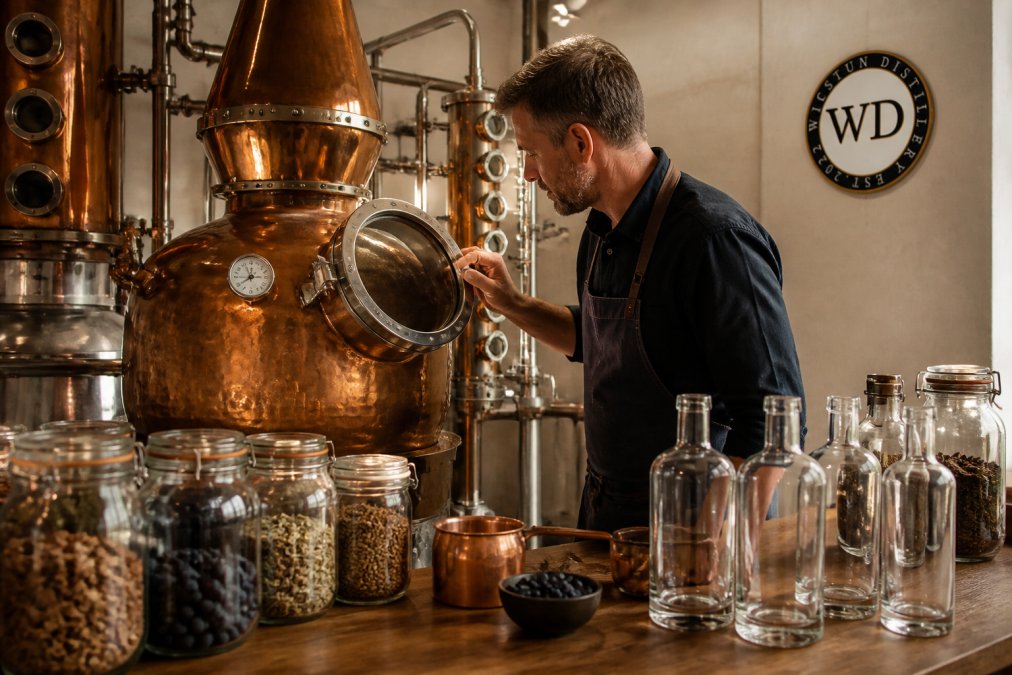
Artisanal gin distillation is the small-batch, hands-on production of gin in which a distiller controls every stage, from botanical selection to the final cut, rather than relying on automated industrial processes. At Wicstun Distillery, we distil in small batches in Market Weighton, which means every run gets watched, smelled and tasted by a person, not a panel of sensors.
That hands-on control is what separates craft gin from mass-produced spirit. A large plant runs continuously and blends for consistency above all else. A small distillery runs batch by batch, adjusting for the character of each botanical load.
So what actually defines "artisanal"? Three things matter most:
- Batch size: Small runs mean closer attention at every stage.
- Distiller involvement: A person makes the cut, not a timer.
- Ingredient quality: Whole botanicals, not extracts or flavourings.
The Food Standards Agency guidance on spirit drinks sets the legal framework for what can be called gin, but craft distillers usually go further, choosing their own botanical recipes and distillation methods.
Botanical Maceration Techniques: How Flavour Gets In
Botanical maceration is the process of steeping botanicals in spirit before distillation so their oils and flavours transfer into the liquid. It is the step where most of a gin's character is decided.
There are two main approaches:
- Traditional maceration: Botanicals steep in the base spirit for hours or overnight before the still is heated.
- Vapour infusion: Botanicals sit in a basket above the liquid, so only the rising vapour picks up their oils.
Traditional maceration tends to give a rounder, deeper flavour. Vapour infusion produces a brighter, more delicate profile. Many distillers combine both, macerating some botanicals and vapour-infusing others.
Juniper is the one botanical that must dominate for a spirit to be called gin. Beyond that, distillers use coriander, angelica root, citrus peel, cardamom, orris root and more. Each one behaves differently in the still, so the recipe is really a set of timing and temperature decisions.
One-Shot Distillation vs Concentrate: Two Routes to the Bottle
The two main routes to a finished gin are one-shot distillation and concentrate distillation. One-shot means the entire batch is distilled once at drinking strength, while concentrate means a highly flavoured spirit is distilled and then diluted.
One-shot distillation produces a gin where the full botanical character comes through in a single pass. It is slower and yields less per run, but the result is often more complex.
Concentrate distillation creates a strong base that is later diluted with neutral spirit. It is faster and more efficient, but some depth can be lost in the process.
Method |
Process |
Flavour Impact |
Best For |
|---|---|---|---|
One-shot |
Distilled once at drinking strength |
Fuller, more complex |
Small-batch craft gin |
Concentrate |
Distilled strong, then diluted |
Lighter, more consistent |
High-volume production |
Most small-batch gin production methods lean towards one-shot distillation because it keeps the distiller in control of the final flavour.
The Cut: Separating Heads, Hearts and Tails
The "cut" is the moment a distiller separates the distillate into heads, hearts and tails, keeping only the hearts for the final bottle. This single decision shapes how a gin tastes more than almost anything else.
As the still runs, the spirit comes off in three phases:
- Heads: The first vapours, sharp and solvent-like. Discarded.
- Hearts: The clean, balanced middle run. This is the gin.
- Tails: The last vapours, oily and heavy. Usually discarded or recycled.
A common mistake is cutting too early to boost yield. The result is a harsh, headache-inducing spirit. Cutting too late drags in heavy oils that dull the citrus and floral notes.
Small Batch Gin Production Methods and the Equipment Behind Them
Small batch gin production methods rely on equipment that gives the distiller fine control over heat, vapour and timing. The still is the heart of it, but the supporting kit matters just as much.
Stills, Condensers and Copper
Copper pot stills are the traditional choice because copper reacts with sulphur compounds in the vapour and removes them, giving a cleaner spirit. A column still can be used for a lighter, more neutral base.
Condensers cool the vapour back into liquid. The design affects how much contact the vapour has with copper, which in turn affects the final smoothness.
A typical small distillery setup includes:
- A copper pot still with a swan neck
- A condenser, often copper or stainless steel
- A botanical basket for vapour infusion
- Collection vessels for heads, hearts and tails
- Hydrometers and thermometers for monitoring
The Scotch Whisky Association guidance on copper contact explains how copper influences spirit character, a principle that applies to gin just as much.
How the Base Spirit Shapes the Finished Gin
The base spirit is the neutral alcohol that carries the botanicals, and its quality sets the ceiling for the finished gin. A poor base cannot be rescued by good botanicals.
Most distillers start with a grain-based neutral spirit. Some make their own from scratch, while others buy in a high-quality neutral and focus on the botanical work. Both approaches can produce excellent gin.
What matters is purity. A base spirit with off-notes will show through, no matter how carefully you distil. This is why a distiller's choice of base is a real quality signal.
For anyone who wants to taste how base spirit and botanicals come together, a distillery tour with gin and rum tasting is the fastest way to understand it. You taste the difference rather than just reading about it.

From Still to Bottle: Judging a Finished Artisanal Gin
Judging a finished artisanal gin comes down to balance, clarity and how the botanicals sit together on the palate. A good gin tastes deliberate, not muddled.
When you taste, work through these checks:
- Nose: Is juniper present and leading? Are other botanicals distinct?
- Palate: Do the flavours balance, or does one dominate?
- Finish: Is it clean and refreshing, or heavy and cloying?
- Mouthfeel: Is it smooth, or does it feel thin or harsh?
A well-made gin holds its character when mixed. If it falls apart in a G&T, the balance was never there. Our own Aromatic Dry Gin is built around cardamom and orange, a pairing that shows how two botanicals can lead a recipe without crowding out the juniper.

Award recognition can be a useful signal here, since judging panels taste blind and score against set criteria. It is not everything, but it is a check that someone other than the maker rates the spirit.
Frequently Asked Questions
What makes gin distillation artisanal compared to mass-produced spirits?
Artisanal gin distillation is defined by scale and attention. Small-batch producers run shorter distillation cycles, make cuts by hand and nose rather than by automated timer, and often macerate botanicals for longer. Mass-produced spirits rely on continuous column stills and neutral base spirit for consistency at volume. The trade-off is that artisanal batches vary slightly from run to run, which many drinkers see as a sign of genuine craft rather than a flaw.
How do botanical maceration techniques change the flavour of a gin?
Botanical maceration techniques control how much flavour the spirit extracts before distillation begins. Steeping botanicals for 12 to 24 hours in the base spirit draws out deeper, rounder notes, while vapour infusion, where alcohol vapour passes through a basket of botanicals, gives a lighter, brighter profile. Citrus peels release oils quickly, so they often need less time than woody botanicals such as cardamom or coriander seed.
What is the difference between one-shot distillation and concentrate production?
One-shot distillation means every drop of spirit in the bottle was distilled in a single run at its final strength, so the character is set once and never diluted down from a stronger concentrate. Concentrate production distils to a high-strength base and then dilutes it. One-shot methods generally produce a fuller, more integrated flavour, which is why many small-batch distilleries choose them for premium gins.
How can I see the artisanal gin distillation process for myself?
Many craft distilleries run guided tours where you can watch the still in action, smell the botanicals and taste the spirit at different stages. A distillery tour with gin and rum tasting is a practical way to see how cuts are made and how base spirit choice affects the finished bottle. It is also a good opportunity to ask the distiller directly about maceration times and batch sizes.
Judging a gin well takes practice, and the fastest way to build that skill is to taste with someone who makes it. Wicstun Distillery is a family-run, small-batch distillery in Market Weighton, and every bottle is hand-distilled and vegan friendly, inspired by the Yorkshire Wolds. Our range spans premium gins, rums, vodkas and liqueurs, all made for people who prefer to drink less and drink better. Get started with Wicstun Distillery and taste what small-batch craft really means.